
‘I want more social cohesion’
Continuing on a spontaneous existing community initiative, sports coach and mentor Ya Koné was able to bring more community spirit to an ever-growing district in Ségou, Mali’s fifth city. The grim circumstances in her country prove that her work is needed now more than ever. Through sport she wants to ensure that youth ‘don’t get off the rails and don’t do bad things.’
It all started with the market, Ya Koné remembers. Ya Koné is a community sports coach in Ségou, approximately 240 kilometers east of Bamako. ‘Our neighbourhood is called Angoulème, in the district Ex-Aviation.’ That’s right, a small military airport used to be situated in this place. ‘This community is relatively new’, Koné says. ‘There was no real community here yet, it had to be built from scratch. There was a new market, however - although with no water. But still, there was something to hold on to. But then the mayor wanted to sell the ground on which the market was based. When the public became aware of those plans, the youth from our community took it over to prevent it being sold. Those are the youth I approached for sports activities’.
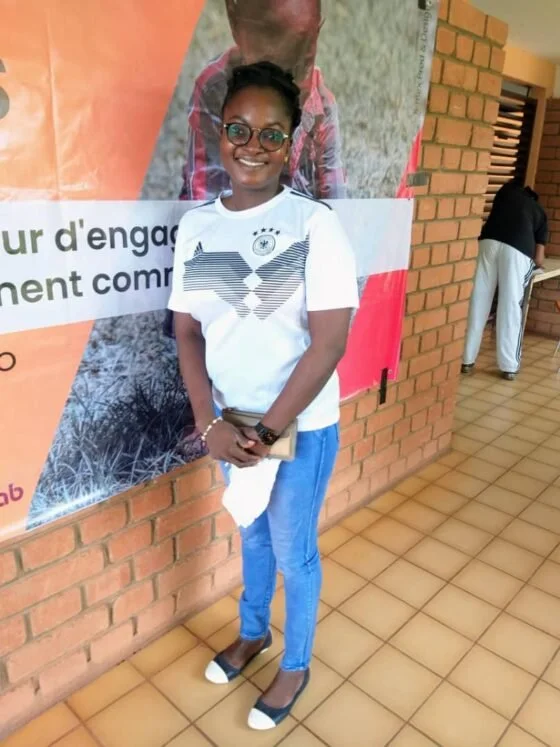
Ya Koné
Is 32 years old, married and mother of three girls: three, five and nine years old. She tells the story about the market with grace. She has been living in Ségou since 2011, and never wants to leave again.
With three colleagues and uncurbed enthusiasm, she is a sports coach to about six hundred youth, here and in other parts of the city. ‘They are almost all high school and college students. They come for the practices and games in the evenings and weekends.’ The activity offer is varied: of course there is football, but you will be surprised to know that also tennis is played. Ya Koné takes the athletics for her account, in particular the running disciplines.
Talking about health
‘Whether I ever wanted a career in sports? Yes, in the past I did think about women’s basketball every now and then; Mali has a reputation in that. But you know what it is like here: without personal relationships you cannot conquer a spot.’ She got a job with a Malian NGO - called Walé - that concerns itself with health problems, and gave up an active sports career.
Sports are still a main part of Ya Koné’s work. In her eyes, sports is not just good for your body; you can also use it as a tool to achieve other goals. ‘You can provide youth a framework, that prevents them to get off the rails and do bad things’, she says.
The connection between sports and mentorship could not be clearer, but, says Koné immediately: you should not think that the work is done after a training session. ‘You help them on their way to independence, but you have to continue following them.’
Building a community
Koné’s work field does not limit itself to the sports field: she is regularly in contact with other community members and the authorities. This can be the mayor, but will often be a bit closer to home, around the corner: the chef de quartier, a community elder that arranges, mediates and contributes to social cohesion.
But she also visits women’s and youth associations. Within this work, she does not see the fact that she is a women as a hindrance. ‘I am completely free in my movements. With this work I meet interesting, and particularly many different types of people. You learn how to deal with others, which has made me a better person also.’
The community, she says, has also improved. There is a much greater sense of community now than before. Her Facebook page is full of praise, about how many youth she has brought - and kept - back on track, and about her tireless efforts.
What you should definitely not do in your role as a coach and mentor, whether it be in Mali or the Netherlands? Without hesitation, she says: ‘Pretend to be better. We work on a base of equivalence and I always emphasise this when working with the youth: we are all the same. You have to be able to communicate well also, that is essential.’
More, More, More
Ya Koné still works for Walé and does her best to keep all the activities going. She manages - not as well as she would like, though - with money that she gathers here and there from projects. Her motive remains the same. ‘I want even more social cohesion, which is not always easy.’
Take the same attitude many youth have, she says: ‘You cannot gather them for new activities if there is no money involved, although building a community demands sacrifices to be made. I manage in the end, but as a country, as a whole, we are not advancing. We have become too materialistic.’
